> For the complete documentation index, see [llms.txt](https://docs.kaichi.xyz/llms.txt). Markdown versions of documentation pages are available by appending `.md` to page URLs; this page is available as [Markdown](https://docs.kaichi.xyz/getting-started/markdown-guidelines.md).
# Markdown Guidelines
Below are some examples of commonly used markdown syntax for posts and articles on Kaichi
## Emphasis
Add emphasis to your text by adding stars (\*) or underscores (\_) around it, like this:
**Bold** - `**double asteriks**`
*Italic* - `*asteriks* or _underscores_`
~~Strikethrough~~ - `~~Scratch this~~`
Underline - `__double underscores__`
Combined ***Bold and Italic*** - `**_double asteriks + underscores_**`
## Headings (for Articles only)
Add a header to your article with this syntax:
```
# One '#' for a h1 header
## Two '#'s for a h2 header
...
###### Six '#'s for a h6 header
```
This is how it will look like:
## Lists
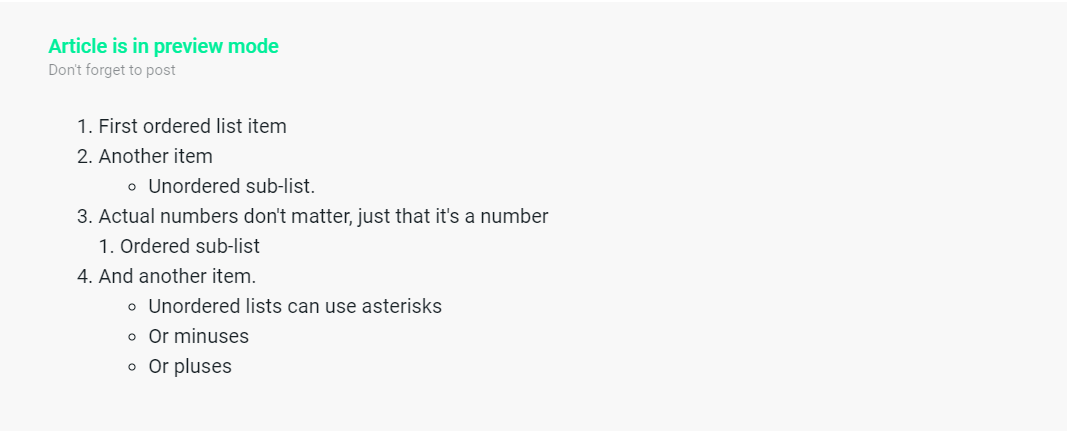
Lists in Articles (example):
Result:
Lists in Posts (example):
Result:
## Links
- URLs will automatically get turned into links [`http://www.example.com`](http://www.example.com)
To write a hyperlink such as: [I am Hyperlink](https://solcial.io) - you can follow this syntax: \
`[I am Hyperlink](https://kaichi.xyz)`
## Inline Images
You can use the following markdown to input images from the internet or your computer: ``